


A shared cybersecurity platform for critical control system networks
SCS is the dedicated cybersecurity layer for an ERTMS-compatible rail traffic control system ecosystem.

SCS is a shared cybersecurity service for multi-vendor control system environments, providing a common identity, access management and certificate infrastructure for all ecosystem stakeholders.
Owned by the infrastructure manager, it ensures interoperability, compliance with EULYNX and EU-Rail cybersecurity requirements, and preserves the infrastructure manager's ownership and control of all identity, logging and configuration data. As a vendor-agnostic solution, SCS enables multiple parallel suppliers to operate through a common interface while supporting future standards evolution without platform redesign. The result is a governable, auditable and clearly accountable cybersecurity framework. Alongside Core SCS, Cinia also offers complementary Technical Support Systems, including backup, name services, secure time synchronisation, maintenance, data management and security monitoring. We also leverage AI to identify alternative development paths and understand interdependencies.
-
Six services, one governance model
SCS is made up of services that reinforce one another. Each can be described and procured as its own component, but they are designed to work seamlessly together — with a shared, normative governance model spanning all of them.
Identity and access management
Lifecycle management of device and system component identities: registration, pairing, authorisation and trustworthy decommissioning — with a single authoritative source of record for the whole ecosystem.
Network access control
Network Access Control enforces network-level access decisions based on identity state managed by IAM — IAM holds the authoritative state, NAC enforces the grant or denial of access on the network.
User authentication
Strong authentication and role-based access control for human users through a standardised interface — covering remote maintenance access and federated sign-in for partner organisations.
Certificate infrastructure
Issuance, lifecycle management and revocation of certificates across the whole supplier ecosystem. A single trust anchor that lets every party verify each other's identity. Also includes signing of device configurations (config signing), which verifies the integrity and origin of a configuration before deployment.
Privileged remote access
Supervised, logged, and where required dual-approved access to critical systems — for both internal staff and equipment suppliers' maintenance personnel.
Centralised log management
Event data from every subsystem, collected in one traceable, integrity-protected location — the foundation for secure log transport and incident detection.
One contract, clear accountability
The infrastructure manager retains decision authority and the authoritative record. Equipment suppliers integrate against one normative interface, with their subsystem's specific characteristics accounted for.
-
Operational support systems — part of the same portfolio
Alongside Core SCS, Cinia's portfolio includes a set of technical support systems that keep the control system ecosystem running, traceable and maintainable. These can be procured together with Core SCS or as standalone components, scaled to need.
-
Managed backup and recoverability of system configurations and critical data — part of the operational continuity foundation across the ecosystem.
-
A reliable, managed Domain Name Service for the control system network's internal and external address space.
-
Secure Time Synchronisation provides a reliable, authenticated time source (NTP/NTS) that other systems and log management depend on.
- Security Maintenance (SP-PRAMSS) provides a per-device maintenance interface: overall security status and integrity check status, certificate maintenance (CRL updates, renewal), read access to audit logs, configuration integrity verification (SHA-512 hashes), controlled factory reset, and testing of security functions (integrity checks, firewall).
- Maintenance and Data Management (EULYNX Eu.Doc.18) provides four service functions to EULYNX field elements: configuration and software upgrade delivery (Loading procedure), diagnostic data collection via OPC UA (Diagnostics collector), time synchronisation, and logging of SCI-XX traffic. In Cinia's architecture, time synchronisation and logging can also be delivered as separate, shared SCS services (STS, Logging) outside MDM — the choice is made case by case together with the infrastructure manager.
- A Security Information and Event Management solution paired with Cinia's Security Operations Center delivers continuous, round-the-clock detection and incident response for the whole ecosystem.
A control system network is only as strong as its weakest interface
Every new subsystem brings its own identity and access management needs. A fragmented approach widens the attack surface and weakens overall oversight.
Industry standards and cybersecurity directives set requirements for identity management, auditability and incident detection — across the entire system lifecycle.
A cybersecurity solution has to support a system's high availability requirements — not undermine them. Governance must be designed together with safety-critical operations, not bolted on afterwards.
A single CSS or interlocking supplier's own cybersecurity solution is built primarily to serve their own equipment — not the whole multi-vendor ecosystem. Once a solution is tied to one supplier, the infrastructure manager ends up either building separate, overlapping cybersecurity solutions for every supplier, or relying on one supplier's judgement of what's sufficient for everyone else. A vendor-agnostic SCS is designed from the start to serve every equipment supplier through the same, unified interface — not as one supplier's extension to the others.
-
SCS in use across Finland's rail traffic control system environment
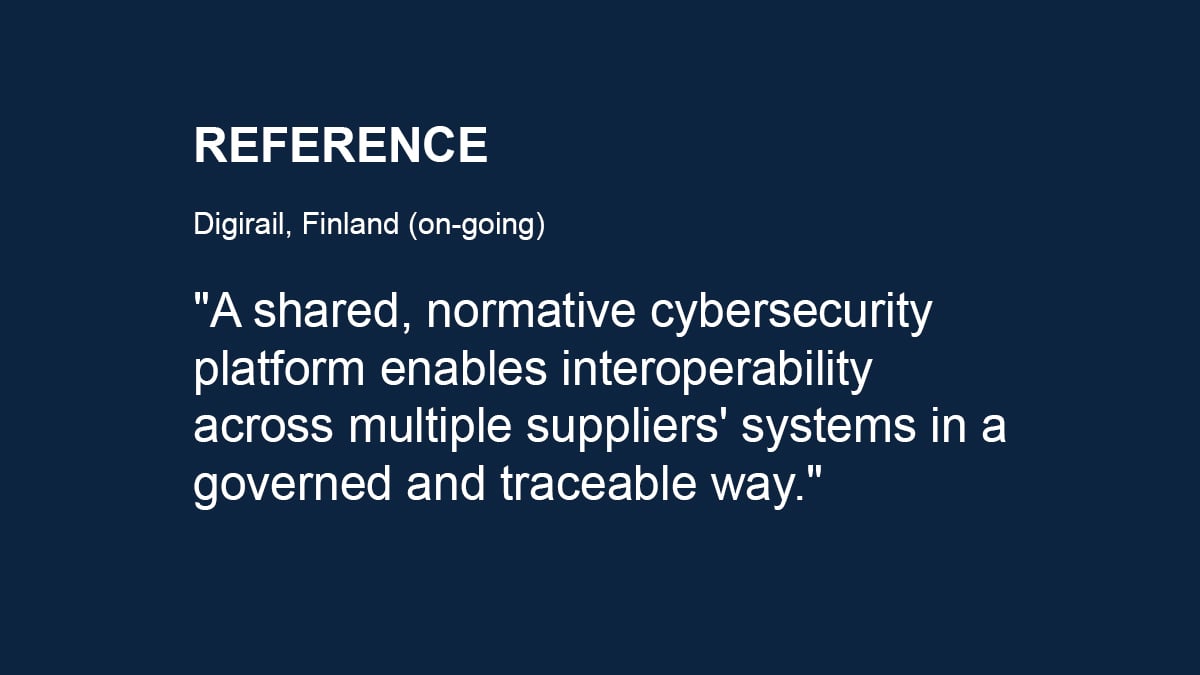
In Finland's rail traffic control system renewal programme, Cinia delivers a shared cybersecurity platform that serves several parallel equipment suppliers and their control system components within one infrastructure manager's ecosystem.
The ecosystem is a genuine multi-vendor environment: CSS systems (control command and signalling / interlocking) are delivered by a different manufacturer than the OC field elements (e.g. track-side equipment such as axle counters). SCS acts as a common interface for all of these suppliers' devices, regardless of who manufactured them.
The solution covers identity and access management, user authentication, certificate infrastructure and centralised log management — built against industry normative requirements and the need for high availability.
Contact us and learn more
Let's discuss whether a shared cybersecurity model fits your ecosystem.
Contact us
-
Markus Ahonen
-
Jussi Kiuru
-
Jukka Poutiainen